Sayuri’s journal
Memoirs of a GeishaSayuri’s journal begins as a private space for thoughts she cannot safely disclose in the world of geisha, but its discovery turns it into the instrument of a decisive reversal. Its coded names preserve the writer’s discretion while making her feelings legible to Hatsumomo; the resulting struggle over the notebook brings Sayuri’s hidden attachment to the Chairman into view and becomes, in her later judgment, the real turning point in her relationship with her rival.
A Private Record in a Discreet World
Several years before Hatsumomo discovers it, Sayuri buys a beautiful blank book at a paper shop and begins recording her life. She knows geisha are expected to be discreet about the men they know, so she confines the writing to her thoughts and feelings rather than setting down the sorts of information a geisha is not expected to reveal. The journal is private not because it contains no desire, but because Sayuri tries to make that desire safe to record.
Her code names turn personal impressions into a guarded, intimate shorthand. She calls Nobu “Mr. Tsu,” after the scornful sound he sometimes makes with his mouth. The Chairman becomes “Mr. Haa,” a name drawn from the slow breath he once let out. Sayuri recalls imagining him waking beside her as he made that sound, a fleeting fantasy that left a powerful impression. The disguise conceals the men’s identities from a casual reader, but it cannot disguise the emotional force of what she writes about them.
The Notebook Becomes a Threat
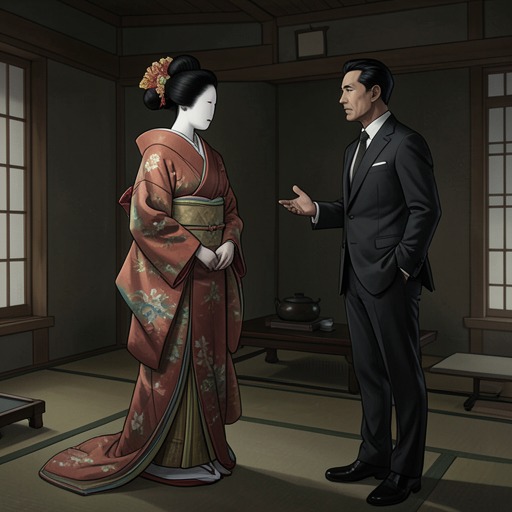
The journal’s privacy collapses when Hatsumomo is found sitting at Sayuri’s little table, reading it. Hatsumomo mocks the writing and its calligraphy, then pages through the notebook to identify “Mr. Tsu” as Nobu. She reads aloud the entry describing how Sayuri can look at Nobu without recoiling from his skin or missing arm, and how she believes his fondness for her grows from that acceptance. What Sayuri had preserved as private thought is now exposed, quoted back to her by an adversary who knows precisely how to make it humiliating.
Sayuri feels sick at the exposure, but also blames herself for having kept the journal where Hatsumomo could find it. Her comparison of the careless shopkeeper’s open window and the rainstorm makes the breach feel both violating and, in her own account, partly enabled by her misplaced trust in secrecy. The object shifts from a private container of memory into a liability: possession of the book gives Hatsumomo power over what Sayuri has written.
Hatsumomo takes the journal toward her room and threatens to bring it to Mother, claiming that its entries concern men and include passages about the head of the household. Her threat makes the notebook’s danger larger than the revelation of Sayuri’s feelings: it could be used to damage her standing within the okiya. Hatsumomo’s drunkenness is visible in the sake she has mistaken for water, but it does not make her threat harmless. As she leaves, she steps on broken glass from an ointment jar and tracks blood and ointment through the upstairs rooms, adding a physical trail of disorder to the conflict over the written record.
A Feint and a Second Deception
Rather than pursue Hatsumomo immediately, Sayuri recalls Mameha’s lesson from the sumo tournament: the obvious move may not be the effective one. She waits for an opening and invents a reason to handle Hatsumomo’s jewelry, raising a brooch before her. While Hatsumomo’s smile fades and she sits stunned, Sayuri reaches down and takes back the journal. The notebook is recovered not through a direct struggle but through a feint that briefly redirects the attention of the woman holding it.
Getting the journal out of Hatsumomo’s hands does not end the danger. Sayuri cannot go to Mother with the book openly, so she hides it between two tissue-wrapped seasonal kimono in a closet. She then opens and closes the drawers of her makeup stand, creating the impression that she has hidden it there. Hatsumomo watches from her doorway with an amused smile, and Sayuri carries the brooch into Mother’s room, where she lays it before her. The two objects now serve different purposes: the journal is concealed evidence, while the brooch becomes part of Sayuri’s effort to expose Hatsumomo’s accusation as a setup.
Hatsumomo tells Mother that Sayuri hid the brooch in her makeup stand and claims she had been trying to protect Sayuri by concealing the journal. Sayuri denies that any journal exists. When Mother follows Hatsumomo back to search, the false trail holds: Hatsumomo closes the drawers slowly, then laughs as though the episode has been a game she has lost. Mother orders her to repay Sayuri for the brooch and to pay for tatami stained with the blood she tracked through the rooms. The concealment has turned Hatsumomo’s attempt to control the journal into a costly defeat.
The Turning Point in the Rivalry
In retrospect, Sayuri distinguishes the journal episode from her mizuage. She recognizes that the mizuage lifted her beyond Hatsumomo’s reach in one important sense, but believes the two women might otherwise have continued living side by side for years. The actual turning point, she says, came on the day Hatsumomo read the journal and Sayuri discovered the brooch she had been accused of stealing. The notebook’s importance therefore lies not only in what it contains: its exposure joins the attack on Sayuri’s private feelings to the false accusation, the counter-maneuver, and the change in their balance of power.
The episode also reveals the limits of the journal’s protection. Coded names can postpone recognition, and a private book can hold feelings that cannot safely be spoken, but neither device guarantees privacy once the object is in someone else’s hands. After Hatsumomo’s career has declined and Sayuri has become the okiya’s daughter and its principal geisha, Mother no longer needs to treat Hatsumomo’s accusation as decisive. The same notebook that briefly gives Hatsumomo leverage thus becomes part of a reversal: Sayuri retrieves it, defeats the attempted exposure, and later names the confrontation as the moment their relationship truly changed.